A large tree on your property is a long-term investment. It adds shade, curb appeal, and real value to your home. But when you notice a trunk beginning to split, a heavy limb pulling away from the main stem, or co-dominant stems growing at a dangerous angle, it can feel like your only option is removal.
It isn’t. In many cases, tree cabling and bracing can stabilize a structurally compromised tree and extend its life by years — or even decades.
What Is Tree Cabling and Bracing?
Cabling and bracing are two complementary techniques that arborists use to provide mechanical support to trees with structural weaknesses. They are among the most effective tools for preserving mature trees that would otherwise need to be removed.
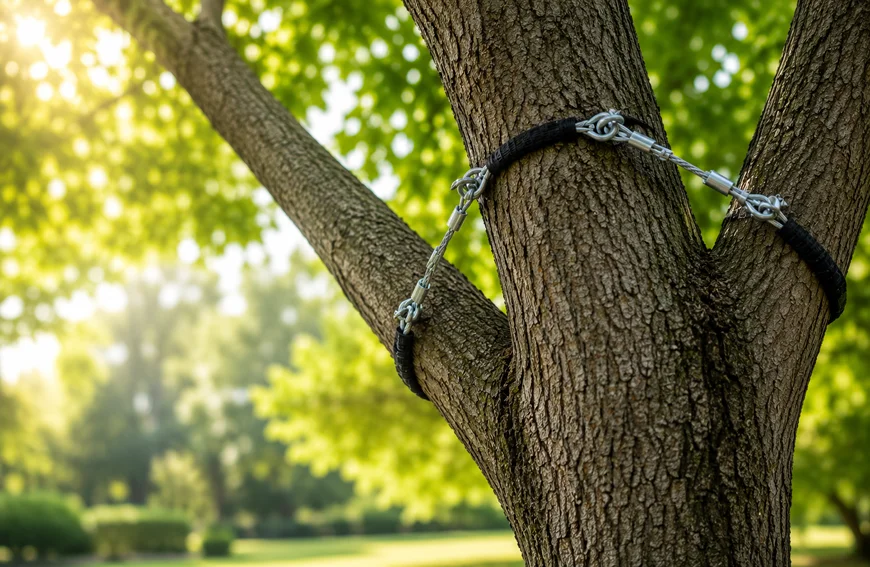
- Cabling involves installing flexible steel or high-strength synthetic cables between major limbs or stems. This limits how far those limbs can move during wind, ice, or heavy storms, reducing the risk of splitting or falling.
- Bracing uses threaded steel rods inserted through weak crotches, split trunks, or co-dominant stems to hold cracked or separating sections together and prevent further movement.
Used together, these systems redistribute stress throughout the tree’s structure — protecting both the tree and anything near it, including your home, fencing, or parked vehicles.
Warning Signs Your Tree May Need Support
Many homeowners don’t notice structural problems until a branch fails or a trunk cracks visibly after a storm. Catching the warning signs early gives you more options and a much better outcome.
Watch for:
- Co-dominant stems — two or more main trunks of similar size growing from the same point, often with a tight V-shaped crotch
- Included bark — bark growing inward between two stems, which weakens the attachment point significantly
- Visible cracks or splits in the trunk or major limbs
- Overextended, heavy limbs leaning over structures, driveways, or pathways
- Previous storm damage that left the tree standing but structurally compromised
- Uneven canopy weight causing the tree to lean noticeably to one side
If you notice any of these signs, it’s worth having a certified arborist assess the tree before a windstorm makes the decision for you. Our team at Five Star Tree Services offers professional consultations across Richmond Hill, Vaughan, Newmarket, and the broader GTA — call us at (416) 990-3355 to book an assessment.
Is Your Tree a Good Candidate for Cabling and Bracing?
Not every tree with structural issues is a candidate for cabling. A tree that is already severely diseased, extensively decayed internally, or actively dying may not benefit from mechanical support. In those cases, tree removal may be the safer and more responsible path.
However, trees that are otherwise healthy but have developed a structural defect — especially mature shade trees, heritage trees, or trees close to your home — are often excellent candidates. The key factors arborists consider include:
- The overall health and vigour of the tree
- The location and severity of the structural weakness
- What the tree is positioned near (structures, utilities, foot traffic)
- Whether the tree has sentimental, heritage, or significant property value
A proper evaluation often includes an arborist report, which documents the tree’s condition, risk level, and recommended course of action. This report can also be valuable if you’re dealing with municipal requirements or insurance considerations.
How the Installation Process Works
Cabling and bracing is not a DIY project. It requires knowledge of tree biomechanics, proper hardware selection, and precise installation to be effective without causing additional harm to the tree.
Here is what the professional process typically looks like:
- Assessment — An ISA-certified arborist inspects the tree, identifies weak points, and determines the right support system.
- Hardware selection — Steel cables are used for high-load situations; synthetic systems (like Cobra or Flexline) offer more dynamic flexibility for living trees. Rods are sized based on the diameter and condition of the affected limbs or trunk.
- Installation — Cables are anchored to strong sections of the canopy using lag hooks or eye bolts. Rods are drilled through and secured with nuts and washers. The system is tensioned correctly to allow natural movement without permitting dangerous separation.
- Follow-up inspection — Cabling and bracing systems need to be checked periodically — typically every one to two years — to ensure they remain effective as the tree grows.
Our team follows the standards set by the International Society of Arboriculture (ISA) and best practices outlined by arboricultural guidelines to ensure every installation is safe and appropriate for the tree.
Cabling and Bracing vs. Removing the Tree
One of the most common questions homeowners ask is whether it’s worth saving a structurally compromised tree or simply having it removed. There is no universal answer, but cabling and bracing is often the better option when:
- The tree is mature and otherwise healthy
- Removal would leave a significant gap in your landscape or privacy screening
- The tree is close to a structure and full removal would be complex and costly
- You want to preserve a tree that has long-standing value on your property
That said, cabling and bracing is a support system — not a cure. It works best in combination with proper tree trimming and pruning to reduce excess canopy weight and eliminate dead or crossing branches that increase structural stress.
In situations where a storm has already caused damage and you’re dealing with a partially fallen or split tree, our storm and emergency tree services team can respond quickly to assess whether the tree can be saved or needs to come down safely.
Don’t Wait for a Storm to Decide
The most common mistake homeowners make is waiting too long. A tree that could have been stabilized with cabling becomes a liability after the first ice storm or high-wind event causes a limb to fail. At that point, you’re no longer choosing between cabling and removal — you’re dealing with emergency cleanup and potential property damage.
If you have a tree on your GTA property showing any of the warning signs above, contact Five Star Tree Services for a professional assessment. Our certified arborists serve Richmond Hill, Markham, Aurora, Newmarket, Vaughan, and surrounding communities. Call us at (416) 990-3355 or request a quote online to get started.
Saving a tree starts with a conversation — and the sooner you have it, the more options you have.