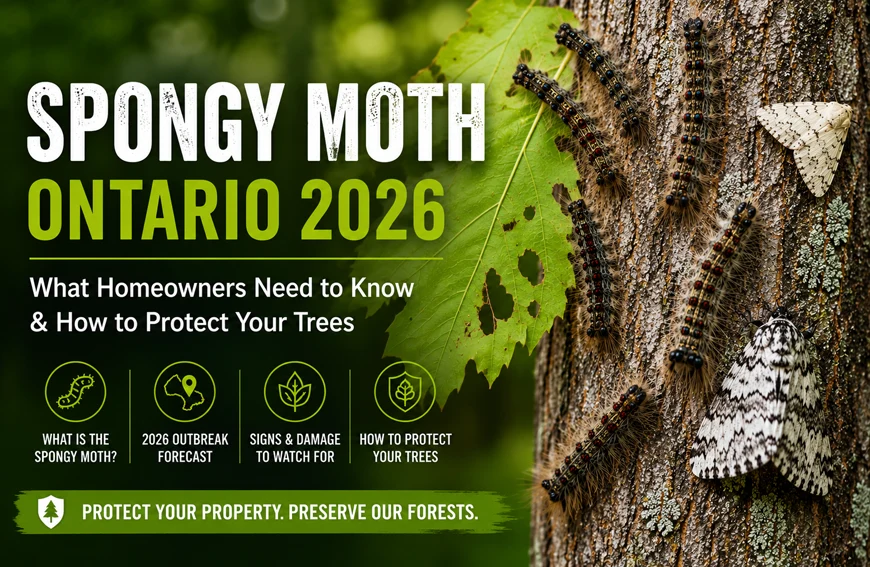
If you’ve noticed caterpillars stripping leaves off your oak or maple, you’re not imagining things. The spongy moth (formerly known as the gypsy moth) is back in the news across the GTA, and while 2026 forecasts are calling for low populations in most municipalities, this invasive pest is cyclical — and your trees can still take a hit if you’re caught off guard.
Here’s what’s happening this season, why it matters for your property, and what you can do about it.
What Is the Spongy Moth?
Spongy moth (Lymantria dispar dispar) is a non-native insect introduced from Europe over a century ago. It’s now firmly established across Ontario, having first been detected in the province in 1969. The caterpillars are the destructive stage of the lifecycle — they emerge in spring, feed heavily on leaves through May and June, then pupate into moths by midsummer.
Trees most at risk include:
- Oak
- Maple
- Birch
- Poplar and willow
- Apple and other fruit trees
In severe outbreak years, even evergreens like pine and spruce can be targeted once preferred food sources run low.
Why 2026 Is a Lower-Risk Year — But Not a Free Pass
Spongy moth populations rise and fall in cycles of roughly seven to ten years, with outbreaks typically lasting two to five years before natural predators, disease, and weather knock numbers back down. Toronto and Mississauga forestry departments have both confirmed that no aerial spraying is planned for 2026, citing low population forecasts following successful management efforts and natural population collapse since the major 2021 outbreak.
That’s good news at the municipal level, but it doesn’t mean every backyard is in the clear. Pockets of higher caterpillar activity can still show up on individual properties, especially on stressed or already-weakened trees. A tree that’s been dealing with drought stress, storm damage, or another pest issue is far less able to bounce back from a heavy feeding season.
Signs Your Tree Has a Spongy Moth Problem
- Ragged or skeletonized leaves, especially in the upper canopy
- Caterpillars with five pairs of blue dots and six pairs of red dots along their backs
- Brownish, fuzzy egg masses on bark, fences, or outdoor furniture
- Visible defoliation by early-to-mid summer
- Frass (caterpillar droppings) accumulating under heavily fed-upon trees
Because the caterpillars’ hairs can cause skin irritation in some people, it’s worth wearing gloves and long sleeves if you’re inspecting or removing them yourself.
What Homeowners Can Do
Burlap banding. Wrapping burlap around the trunk gives caterpillars a place to shelter during the day, where they can be collected and disposed of. This is most effective from May through September.
Egg mass removal. Scraping egg masses off bark between fall and early spring, before they hatch, is one of the most effective ways to reduce next year’s population on your property. Masses should be soaked in soapy water for at least 48 hours before disposal.
Tree health maintenance. A vigorous, well-maintained tree recovers from defoliation far more easily than a stressed one. Regular tree trimming and pruning removes dead or weak wood and improves airflow and light penetration, both of which support faster recovery after a feeding season.
Structural support for vulnerable trees. If a mature tree has already been weakened by repeated defoliation, storm damage, or co-dominant stems, cabling and bracing can reduce the risk of limb failure while the tree regains strength.
Professional assessment. If you’re not sure whether your tree’s condition is from spongy moth, another pest, or an unrelated issue, an arborist report gives you a clear, documented picture of tree health and a tailored care plan.
When Removal Becomes Necessary
Most healthy deciduous trees can survive a season or two of defoliation. But trees already in decline, especially evergreens that can’t regrow needles as readily, may not recover from a severe feeding event. If a tree shows signs of irreversible dieback, structural failure, or is a hazard to your home, our tree removal team can evaluate your options safely.
Spongy moth isn’t the only invasive pest GTA homeowners are watching this season. If you’re dealing with ash trees, our guide to emerald ash borer in the GTA covers identification and treatment options, and our spotted lanternfly guide breaks down the newest invasive threat to hit the region. (Note to Kourosh: please confirm both slugs against the live post sitemap before publishing — the sitemap fetch I ran is truncated at 2022 and doesn’t reflect recently published posts.)
For broader background on the species, the Government of Ontario’s spongy moth page and the City of Toronto’s spongy moth resource are both useful references.
Don’t Wait for Defoliation to Spread
Whether you’re seeing early signs of caterpillar activity or just want a professional opinion before the feeding season ramps up, Five Star Tree Services is here to help GTA homeowners protect their trees. Request a quote today, or call us at (416) 990-3355.