Beech trees are among the most handsome trees in the GTA, from the smooth grey trunks of native American beech in local woodlots to the purple and copper European beeches and tall beech hedges found in many older neighbourhoods. A relatively new disease is now putting them at risk.
Beech leaf disease has been spreading through southern Ontario since it was first found in the province in 2017. It’s been confirmed on a European beech hedge in Toronto and in communities east and west of the city along Lake Ontario. In 2026, it was found on a private property in Cobourg’s west end. Here’s what homeowners should know about beech leaf disease in Ontario and how to spot it early.
What Is Beech Leaf Disease?
Unlike most leaf diseases, beech leaf disease isn’t caused by a fungus. It’s caused by a microscopic roundworm, a nematode called Litylenchus crenatae mccannii. The nematodes live inside beech buds and leaves, where they feed on leaf tissue as it develops.
The disease was first discovered in Ohio in 2012 and has since spread through much of the northeastern United States and into Ontario. As infected trees lose healthy leaves year after year, they produce fewer buds, their canopies thin out and they eventually decline. Young trees and understory beeches can die within a few years. Large trees usually decline more slowly but are weakened over time.
Signs of Beech Leaf Disease
Symptoms are easiest to see from late spring through summer. Look for:
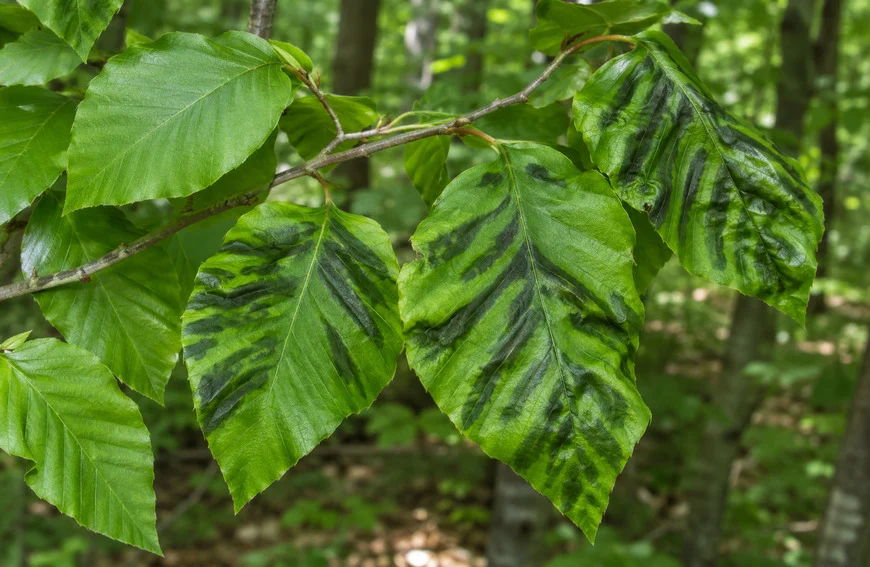
- Dark bands between the leaf veins. This is the classic sign. The leaf shows dark green, striped bands running parallel to the veins. They’re easiest to see when you look up at a leaf from underneath with the sun behind it.
- Thick, leathery leaves. Banded areas feel thicker than healthy tissue.
- Curled, shrunken or crinkled leaves, especially in more advanced cases
- A thinning canopy with fewer leaves and dead buds
- Yellow or brown leaves and early leaf drop on heavily infected trees
Symptoms often show up first on lower branches and on small beech saplings in the understory.
Which Beech Trees Are at Risk?
Several types of beech grown in the GTA can be infected:
- American beech, the native species found in woodlots, ravines and naturalized yards
- European beech, including popular ornamental varieties like copper, purple, weeping and fern-leaf beech
- Beech hedges, which are common in older GTA properties and can be costly to replace
Because hedges are planted so densely, the disease can move quickly from one plant to the next.
Why Fall and Winter Matter
The nematode doesn’t disappear when the leaves fall. It overwinters inside beech buds and in infected leaves that have dropped to the ground. That gives homeowners a few useful things to do in the off-season:
- Clean up fallen beech leaves and keep them on your property. Don’t give them away or bring them to another garden for mulch.
- Have trees assessed in winter. An arborist can check bud density and canopy condition when branches are bare and plan any pruning or removal work.
- Mark suspect trees now so you can confirm symptoms when the new leaves open in spring.
Help Stop the Spread
Scientists are still learning exactly how the nematode moves, but moving infected material is one known risk. To help:
- Don’t move beech leaf litter off your property
- Don’t move firewood. Buy it where you burn it.
- Don’t transplant beech saplings from woodlots or other properties
- Buy new beech trees and hedge plants only from reputable nurseries
- Clean pruning tools between trees
These steps are similar to the advice for other invasive threats in our area, like the emerald ash borer and spongy moth.
Can Infected Trees Be Treated?
There’s currently no proven cure for beech leaf disease. Researchers in Canada and the United States are testing treatments, but none has yet been shown to fully stop the disease. What you can do is give infected trees the best chance to cope:
- Water deeply during dry spells
- Mulch the root zone to keep soil moist and protect roots
- Avoid soil compaction and root damage from construction
- Remove dead branches that could fall and cause damage
For beech hedges, regular hedge and shrub trimming helps you keep an eye on the plants and remove declining sections before they spread problems further.
When Removal Makes Sense
Removal may be the right choice when a beech has lost much of its canopy, has large dead limbs, or stands close to a house, driveway or play area where falling branches are a hazard. Small, heavily infected saplings are often removed early to reduce the amount of infected material on the property.
An arborist report can document the tree’s condition, which is helpful if you need a permit. When the time comes, our tree removal team can take the tree down safely.
How to Report Beech Leaf Disease
Reporting new sightings helps researchers track how fast the disease is moving. If you think you’ve spotted it, take clear photos of the banded leaves and the whole tree, then report it through EDDMapS Ontario or the Invading Species Hotline at 1-800-563-7711. You can learn more on the Ontario government’s beech leaf disease page.
Worried About Your Beech Trees?
Catching beech leaf disease early gives you more options for managing it. Five Star Tree Services helps homeowners across the GTA assess, care for and, when needed, safely remove beech trees and hedges.
Call (416) 990-3355 or request a free quote. We’re based at 156 Duncan Rd, Richmond Hill.