Emerald Ash Borer in the GTA: How to Protect Your Ash Trees in 2026
If you have an ash tree on your property anywhere in the Greater Toronto Area, there’s a good chance it has already been exposed to the emerald ash borer. This small, metallic-green beetle has been quietly devastating Ontario’s ash population for nearly two decades, and most homeowners don’t notice an infestation until it’s too late to save the tree.
Here’s what every GTA property owner should know about this invasive pest, how to spot the warning signs, and what your options are if your ash tree is already infested.
What Is the Emerald Ash Borer?
The emerald ash borer (EAB) is an invasive beetle native to Asia that was first confirmed in Ontario in 2002, near Windsor. It reached the GTA by 2007, and since then it has killed hundreds of thousands of ash trees across Toronto alone.
A few key facts about this pest:
- It attacks every species of true ash tree (Fraxinus), including white, green, black, red, and blue ash
- Adult beetles are roughly 8.5 to 14 mm long with a metallic blue-green sheen
- The larvae do the real damage, tunnelling under the bark and cutting off the tree’s water and nutrient flow
- Once a tree is infested, mortality is close to 100% without treatment
Unlike some pests that target only weak or stressed trees, EAB attacks healthy ash trees just as readily as struggling ones. There are also no natural predators in North America to keep its population in check, which is part of why it has spread so aggressively since arriving in Canada.
Signs Your Ash Tree May Be Infested
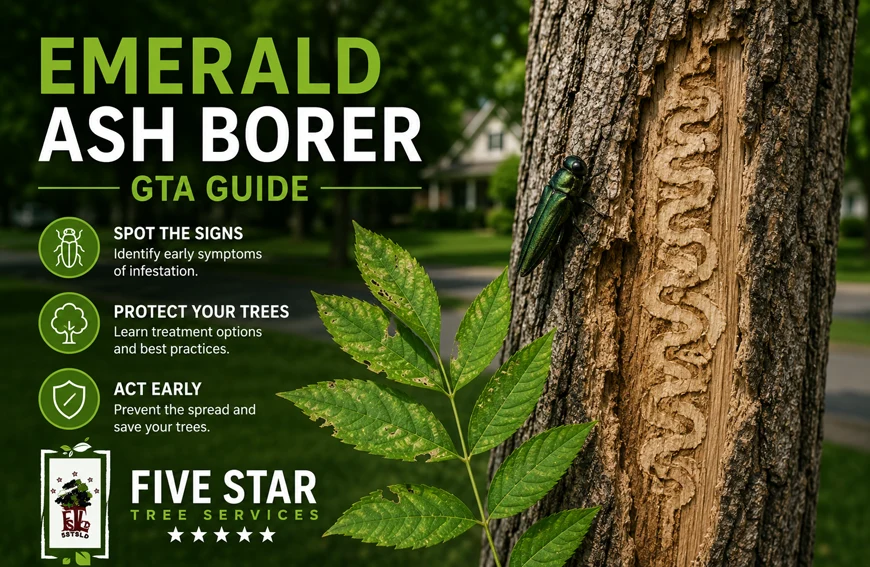
EAB damage happens underneath the bark, so by the time visible symptoms appear, the infestation is often already well established. Watch for:
- Canopy thinning or dieback, usually starting at the top of the tree and working downward
- D-shaped exit holes in the bark, about 4-5 mm across, left behind when adult beetles emerge
- Epicormic shoots — clusters of new growth sprouting from the trunk or main branches, a stress response from the tree
- Bark splitting that reveals S-shaped tunnels (galleries) underneath
- Increased woodpecker activity, since woodpeckers feed on the larvae and often leave telltale strips of bark removed
If you notice any of these signs, the tree should be assessed quickly. An arborist report can confirm whether EAB is the cause and how advanced the infestation is, which determines whether treatment is still realistic.
Can an Infested Ash Tree Be Saved?
Sometimes — but timing matters. The City of Toronto’s forestry program treats select ash trees with TreeAzin, a systemic insecticide that can slow EAB populations and protect trees from significant damage when applied early enough. This option tends to work best on trees that are still in the early stages of infestation and have enough healthy vascular tissue left to carry the pesticide through the trunk.
Once a tree has lost a significant portion of its canopy or shows extensive bark splitting, treatment is rarely effective, and removal becomes the safer and more practical choice.
Why Removal Is Often the Outcome
Dead and dying ash trees become structurally unstable fairly quickly. As the wood dries out and the trunk weakens, branches can fail without warning, and that’s a real hazard if the tree is anywhere near a house, driveway, or power line. Many municipalities, including Toronto, actively monitor and remove ash trees on public property for exactly this reason.
If EAB has compromised a tree on your property, our tree removal team can safely take it down before it becomes a liability. For trees that have already failed or come down in a windstorm, our storm and emergency tree services are available for urgent response throughout the GTA.
Removal is usually just the first step. Once the tree is down, the stump is often left behind:
- A standing stump can attract further pests and fungal decay
- It takes up usable yard space and can be a tripping hazard
- Roots can continue to grow and interfere with nearby hardscaping
Our stump grinding service clears the area quickly so you can replant or landscape without waiting for natural decomposition.
Don’t Move Infested Firewood
One of the biggest reasons EAB has spread so quickly across Ontario is firewood movement. The beetle only travels a few kilometres on its own each year, but it can hitch a ride for hundreds of kilometres inside untreated firewood, logs, or nursery stock. The Canadian Food Inspection Agency (CFIA) regulates the movement of ash material out of infested areas for this exact reason, and is currently re-evaluating its national EAB management strategy with a decision expected later in 2026.
If you’re cutting down an infested ash tree, the safest practice is to use the wood locally rather than transporting it to a cottage or another property.
Replacing an Ash Tree
If you’ve lost an ash tree to EAB, replanting with a diverse mix of species is the best way to protect your property from future pest outbreaks — a single-species landscape is far more vulnerable to the next invasive insect that comes along. Our tree planting and transplanting team can help you choose resilient, climate-appropriate species for the GTA.
EAB isn’t the only invasive insect putting GTA trees at risk right now. We’ve also covered what homeowners need to know about the spotted lanternfly in Ontario, another pest spreading through the region that’s worth keeping an eye on.
Get an Ash Tree Assessed Before It Becomes a Hazard
If you suspect emerald ash borer has reached your property, don’t wait for the canopy to thin out completely. Early assessment gives you the most options, whether that’s treatment, monitoring, or planned removal on your terms rather than in an emergency.
Contact Five Star Tree Care for a professional assessment, or call us directly at (416) 990-3355. We serve Richmond Hill, Aurora, Newmarket, Stouffville, Vaughan, Markham, North York, and Toronto.