

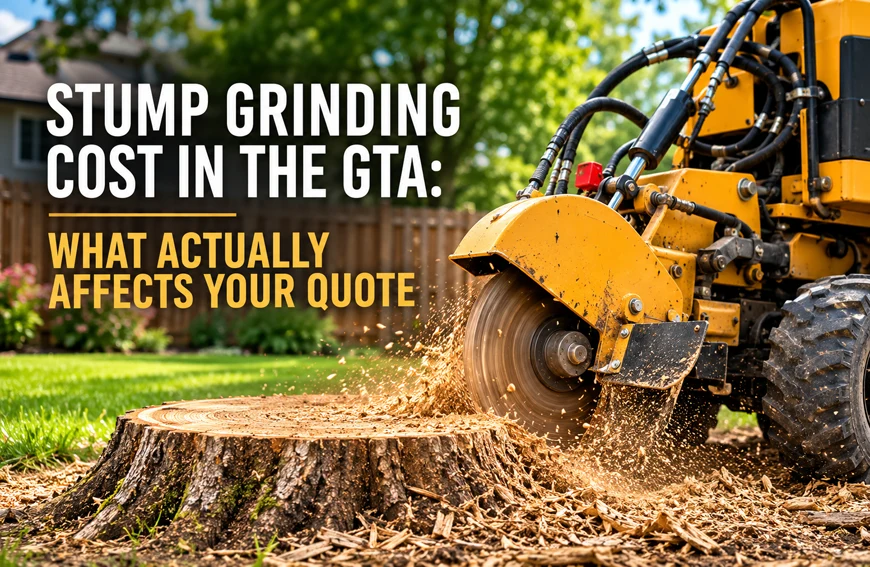
If you’ve got a stump sitting in your yard and you’re trying to figure out what it’ll cost to have it ground down, you’ve probably noticed that pricing online is all over the map — anywhere from a couple hundred dollars to well over a thousand. That range isn’t random. Stump grinding quotes in Richmond Hill, Toronto, and across the GTA are built from a handful of specific factors, and understanding them makes it much easier to know whether a quote is fair. For a full walkthrough of how the grinding process itself works, see our complete guide to stump grinding. This article breaks down what drives the price.
The Biggest Factor: Stump Diameter
Most GTA stump grinding quotes scale directly with the diameter of the stump, measured across the top at ground level. As a rough guide, homeowners can generally expect:
- Small stumps (under 12 inches) — the lowest end of the price range
- Medium stumps (12–24 inches) — a moderate step up
- Large stumps (24–36 inches) — significantly more, due to the size of the grinding wheel and time required
- Extra-large or mature hardwood stumps (36+ inches) — the highest end, especially for dense wood
A backyard maple stump and a curbside spruce stump of the same width won’t always cost the same either — which brings us to wood type.
Wood Species and Density
Hardwoods like oak, maple, and beech take longer to grind through than softer woods like pine or spruce, and that extra time and equipment wear is usually reflected in the quote. If you know what species you’re dealing with, it’s worth mentioning it when you request a quote so the estimate is accurate from the start.
Site Access
Access is one of the most underestimated pricing factors. A stump sitting right next to the driveway, with clear space for equipment, is straightforward. A stump tucked behind a fence, down a narrow side yard, or on a slope may require smaller equipment, more manual labour, or extra time — all of which affect cost. Before booking, it’s worth measuring gate widths and clearing a path if possible.
Root Spread and Surrounding Hardscaping
Stumps with large surface roots that have spread under a patio, walkway, or garden bed take longer to grind cleanly, especially if the crew needs to work carefully around interlock, irrigation lines, or a retaining wall. If roots are already lifting nearby concrete, that’s a related but separate issue — our tree root grinding article covers that specific situation in more detail.
Grinding Depth
Standard residential grinding typically goes down several inches below grade — enough for turf or garden beds to go back over the area. If you’re planning to install a driveway, patio, or new planting bed directly over the spot, a deeper grind (or full removal) may be necessary, which adds to the cost. Let your contractor know your plans for the space up front.
Number of Stumps on the Property
If you have more than one stump to grind, most GTA companies offer a reduced per-stump rate for additional stumps ground during the same visit, since equipment mobilization is the same regardless of stump count. If you’re clearing several stumps at once, ask specifically about multi-stump pricing.
Debris and Cleanup
Grinding produces a substantial pile of wood chips and mulch. Some quotes include hauling this debris away and backfilling the hole with topsoil; others leave the chips on-site for the homeowner to deal with. Always confirm whether cleanup and backfill are included before comparing quotes side by side — a lower number that excludes cleanup isn’t necessarily the better deal.
Permits: When They Do (and Don’t) Apply
Grinding the stump of a tree that has already been removed generally does not require a municipal permit on its own. However, if the tree is still standing and meets your municipality’s protected size threshold — commonly a trunk diameter of 30 cm or more in Toronto — removing the tree itself requires a permit before any cutting begins. If you’re not sure whether your tree falls under this threshold, our tree removal permit service can help you confirm before work starts.
Utility Locates Before Digging
Even though grinding doesn’t excavate the way full stump removal does, it still disturbs the ground around the stump. Ontario law requires a locate request through Ontario One Call before any digging or ground disturbance, so it’s worth confirming this has been requested — whether you or your contractor submits it — before equipment shows up.
Grinding vs. Full Stump Removal
It’s worth noting that grinding and full removal are priced very differently, because they’re different jobs. Grinding shaves the stump below grade and leaves the root system to decay naturally over several years — faster, less disruptive, and generally the more affordable option. Full removal excavates the entire root ball, which is necessary if you’re building a foundation, pool, or driveway directly over the spot, but it costs considerably more due to the equipment and labour involved. If you’re planning major construction near the stump, see our stump removal page to compare.
Getting an Accurate Quote
The most reliable way to get an accurate number is to have someone assess the stump in person — photos and phone descriptions can only go so far when access, root spread, and wood density all affect the price. At Five Star Tree Care, we provide free, no-obligation quotes for stump grinding across Richmond Hill, Toronto, Markham, Vaughan, Aurora, and Newmarket, and we’re upfront about what’s included in the price — cleanup and all.
Call us at (416) 990-3355 or request a quote to get a straightforward number for your property.