
Most homeowners think of spring as planting season, but fall is actually the better window for trees in the GTA. Cooler air slows top growth, while the soil stays warm enough for weeks after the leaves drop, giving roots time to establish before winter without the stress of summer heat.
The trick is timing it correctly and choosing species that actually benefit from a fall start. Here’s what to plant, when, and how to give a newly planted tree its best shot before the ground locks up.
Why Fall Planting Works
When a tree goes into the ground in fall, it isn’t trying to support new leaves or fight summer heat at the same time it’s growing new roots. Instead, all of its energy goes into root establishment while the tree is heading into dormancy.
The GTA’s climate happens to be well suited to this. North GTA suburbs like Richmond Hill, Vaughan, Markham, and Newmarket typically see their first frost between mid and late October, while Toronto’s urban core often stays frost-free into early November. That gap gives a planted tree several extra weeks of workable soil, and the soil itself typically stays above freezing well after the air does.
The Planting Window
For most of the GTA, the ideal fall planting window runs from early September through mid-October, with the goal of getting roots established at least 4 to 6 weeks before the ground freezes solid.
A few timing notes:
- Earlier is generally better than later — a September or early October planting gives roots more time to settle before dormancy
- North GTA properties should aim to finish by mid-October given the earlier frost
- Toronto’s milder microclimate allows a bit more flexibility into late October
- Once nighttime temperatures are consistently at or below freezing, it’s time to stop planting and let any newly installed trees settle in for winter
Trees That Do Well With a Fall Start
Not every species handles fall transplanting equally well. Trees with fibrous, fast-establishing root systems tend to be the best fall candidates, while a few species are better left for spring.
Good options for fall planting in the GTA:
- Red maple and sugar maple — fast-rooting and well adapted to southern Ontario soils
- Serviceberry — a smaller native tree that tolerates transplanting well and offers spring bloom and fall colour
- Bur oak and red oak — slower growing but long-lived, and fall planting suits their root habit
- Ironwood (hophornbeam) — a tough, shade-tolerant native that establishes reliably in cooler soil
- Spruce and pine — evergreens generally transplant well in fall since they aren’t shedding leaves and can continue root growth into cooler weather
Species better saved for spring instead include birches, magnolias, and some flowering dogwoods, which tend to be more sensitive to root disturbance heading into winter.
Site and Soil Prep
Where you plant matters as much as what you plant. Before digging, check the mature size of the species you’ve chosen against nearby structures, fences, and any overhead or underground utility lines.
- Dig the hole two to three times wider than the root ball, but no deeper than the root ball itself
- Loosen the surrounding soil so roots can spread rather than circle
- Backfill with the native soil you removed rather than heavily amended soil, which can discourage roots from growing outward
- Water deeply immediately after planting to settle the soil and eliminate air pockets
Mulching and Winter Protection
A newly planted tree’s first winter is its most vulnerable. A few basic steps make a meaningful difference in survival rates.
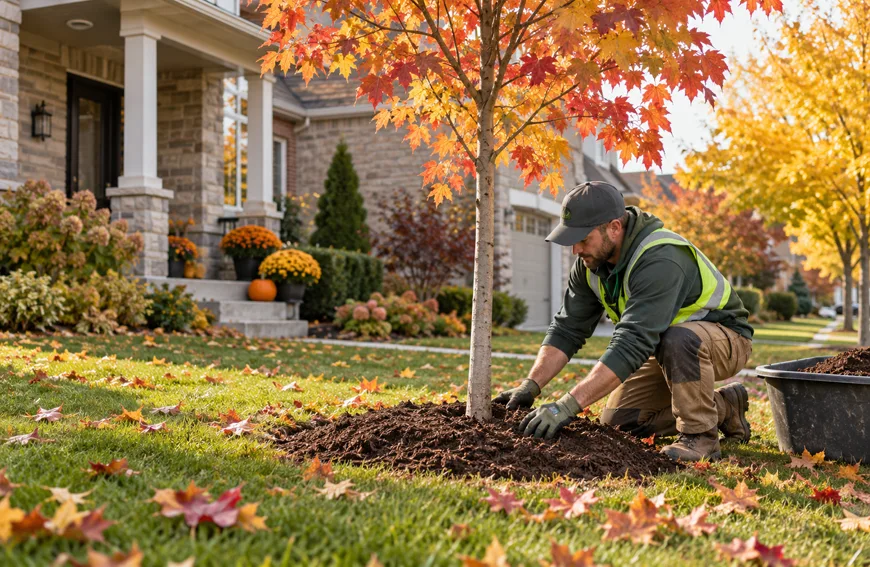
- Apply 5 to 8 cm of mulch around the base, keeping it a few centimetres clear of the trunk to avoid rot
- Continue watering through fall until the ground freezes, since roots are still active even after leaves drop
- Wrap the trunks of young or thin-barked trees to reduce frost cracking and animal damage over winter
- Avoid fertilizing at planting time — it encourages leaf growth the tree doesn’t need going into dormancy
When to Bring in a Professional
Fall planting is fairly forgiving, but species selection and placement mistakes are expensive to fix once a tree is established. An arborist can confirm which species suit your specific lot, soil, and sun exposure, and can also advise on spacing relative to your home’s foundation and existing trees.
If you’re planning any fall planting or want to check the timeline against the rest of your fall tree care, our fall tree preparation timeline walks through the full seasonal checklist. For the planting itself, our tree planting and transplanting team can help with species selection, siting, and proper installation.
Five Star Tree Care serves Richmond Hill, Toronto, Markham, Vaughan, Aurora, and Newmarket. If you’d like a second opinion on species or placement before you plant, an arborist report can help you avoid costly mistakes. Request a quote or call (416) 990-3355 to get started before the ground freezes.
For more on which species suit our region’s climate zone, the Government of Canada’s Plant Hardiness Zones resource is a useful reference when choosing species for a GTA property.