If you live in Markham, Vaughan, Richmond Hill, Newmarket, or Aurora, your outdoor watering is already limited by a municipal bylaw — and most homeowners only think about it in terms of their lawn. Your trees are affected too, and unlike grass, a mature tree that goes through a stressed, under-watered summer doesn’t bounce back in a week. The damage can take months or years to show up, often as dieback, pest vulnerability, or a weakened limb that fails in the next storm.
Here’s what the current watering rules mean for your trees, how to tell if yours are already struggling, and what you can do about it within the bylaw.
What the York Region Watering Bylaw Actually Covers
Every municipality in York Region runs an odd/even outdoor watering schedule from May 15 to September 30, tied to your street address. Depending on your city, watering is typically permitted in set morning and evening windows, and using a hose, sprinkler, or irrigation system outside your assigned day can result in a fine.
A few details matter specifically for tree owners:
- Newly planted trees and shrubs get a short exemption — most municipalities allow watering outside the regular schedule for a limited period right after planting, since new root systems need consistent moisture to establish.
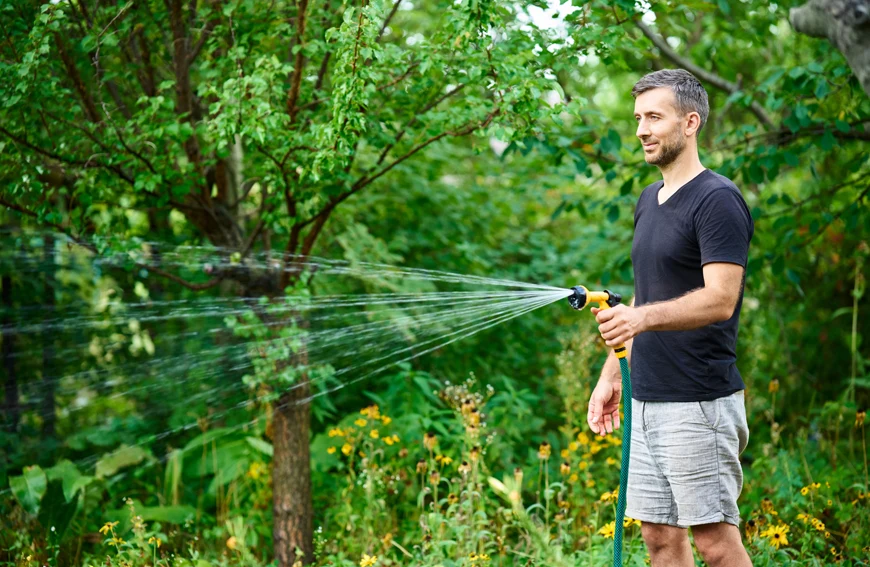
- Hand watering and drip irrigation are treated differently in many municipalities than sprinklers, and are often allowed more flexibly.
- The bylaw runs every year, not just in dry years — it applies whether or not the region is officially in drought, so it’s worth building into your normal summer routine rather than waiting for a warning. You can confirm your city’s exact schedule and hours through York Region’s outdoor water-use bylaw page.
If you’re planting or replacing a tree this season, our tree planting and transplanting team can also walk you through the establishment-watering exemption for your specific municipality.
Signs Your Tree Is Already Under Stress
Trees don’t wilt dramatically the way garden plants do, so drought stress is easy to miss until it’s advanced. Watch for:
- Leaves that are smaller than usual, curling, or turning brown at the edges mid-summer
- Early fall colour or leaf drop in July or August
- A thinning canopy with more visible sky through the branches
- Bark that’s cracking, peeling, or pulling away from the trunk
- Wilting or drooping on newer growth, even in the morning before heat sets in
Any one of these on its own isn’t necessarily an emergency, but a tree showing several of them — especially one that was recently planted or already had a health issue — is worth a closer look.
Watering Trees Effectively Within the Rules
Lawns need frequent shallow watering; trees need the opposite. A few adjustments make a real difference without breaking your local bylaw:
- Water deeply and slowly on your assigned day, letting it soak down 15–20 cm rather than just wetting the surface
- Apply a 5–8 cm layer of mulch around the base, kept away from the trunk itself, to slow evaporation between watering days
- Prioritize newly planted trees and anything already showing stress signs over established, healthy specimens
- Use a soaker hose or drip line at the drip line of the canopy rather than right at the trunk, where most of the water-absorbing roots actually are
Why a Stressed Tree Becomes a Bigger Problem Later
Drought-stressed trees don’t just look worse — they become measurably more vulnerable. Weakened trees have less energy to produce natural defenses against insects and disease, which is part of why pest pressure tends to hit hardest on trees that were already struggling. We’ve seen this play out with the emerald ash borer and other invasive pests currently active across the region, where stressed trees decline faster once infested.
Stressed wood is also more brittle, and brittle limbs are exactly what fails in the wind and thunderstorm activity the GTA sees through the rest of summer. If a tree on your property has been struggling with heat and limited water, our storm and emergency tree services team can help you get ahead of the next one rather than waiting to see what comes down.
When to Call a Professional
A homeowner can usually judge whether their lawn needs water, but assessing a mature tree’s health and structural risk is a different skill. If you’re seeing multiple stress signs, or a tree has both drought stress and visible deadwood, cracking, or lean, it’s time for a professional opinion rather than guesswork.
An arborist report can assess whether the issue is watering, root damage, disease, or something structural, and recommend next steps — whether that’s a deep watering and mulching plan, pruning out dead or hazardous limbs, or, in more serious cases, planning for removal before the tree becomes a liability. For general watering guidance backed by research, the International Society of Arboriculture’s consumer resource, Trees Are Good, is a solid reference alongside your arborist’s on-site assessment.
If you’re not sure whether your trees are handling this summer well, Five Star Tree Care can take a look and tell you plainly what’s going on and what — if anything — needs to happen next.
Ready for a professional assessment? Request a quote or call us at (416) 990-3355.