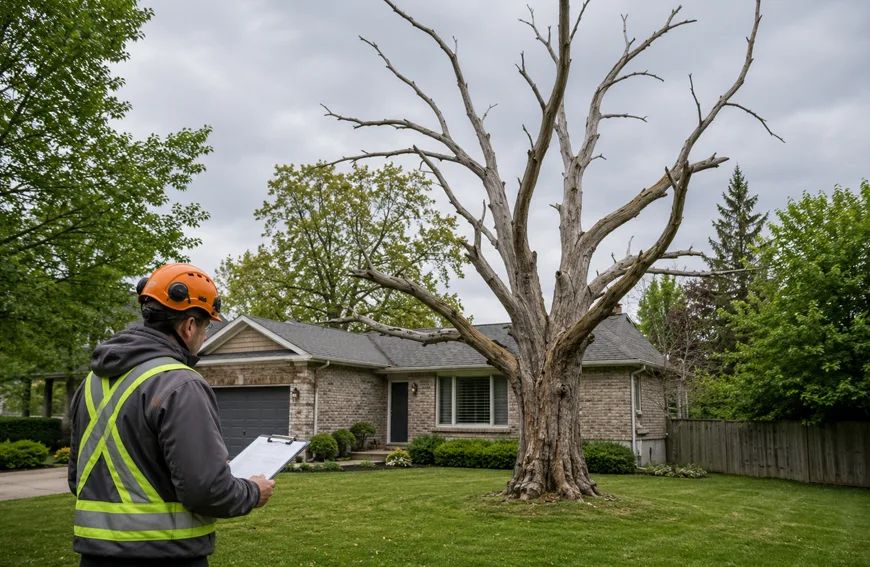
A dead tree in the yard feels like an easy call — it’s not coming back, so why not just cut it down? In the Greater Toronto Area, the answer depends entirely on which city you live in, and getting it wrong can mean a fine of up to $100,000 per tree. Some municipalities let you skip the permit process for a fully dead tree. Others still require documentation before a single branch comes down.
Here’s how the rule actually works across Richmond Hill, Toronto, Markham, Vaughan, Aurora, and Newmarket.
Why “It’s Dead” Isn’t Automatically a Green Light
Every GTA municipality regulates tree removal above a certain trunk diameter, and most extend that protection to dead, dying, and hazardous trees — not just healthy ones. The logic is simple: a homeowner isn’t a qualified judge of whether a tree is genuinely dead, partially dead, or just dormant, and cities don’t want the dead-tree label used as a workaround for the permit process.
That means in most cases, the real question isn’t “do I need a permit,” it’s “what documentation do I need before I can remove it without one — or with a fee waiver.”
Toronto: A True Dead-Tree Exemption
Toronto is the most straightforward city in the region on this point. Under Chapter 813, a permit is generally not required to remove a tree that is confirmed 100% dead. If there’s any doubt about whether the tree is fully dead, its ownership, or whether it sits in a ravine or protected natural area, the City recommends confirming before work starts.
Where this trips people up:
- A tree that’s mostly dead but has some green growth left doesn’t qualify for the exemption
- Boulevard and City-owned street trees are never a homeowner’s call, dead or not
- Ravine and natural feature areas can carry extra restrictions even for dead wood
Richmond Hill: The Rule Just Changed
This is where a lot of outdated advice online causes problems. Richmond Hill’s older Tree Preservation By-law 41-07 allowed more flexibility for dead or hazardous trees. The current Tree Preservation By-law 19-25 applies to any private tree 15 cm DBH or larger — and dead, dying, and hazardous trees are still covered by the permit framework, not automatically exempt from it.
In practice, that means:
- An Arborist Report or Tree Risk Assessment is required to document the condition
- Emergency Work provisions exist for genuinely urgent situations, but still call for arborist documentation, often submitted before or immediately after the work
- Skipping this step because “it was obviously dead” doesn’t protect you if the City disagrees after the fact
Markham, Vaughan, Aurora, and Newmarket
Rules across the rest of York Region follow a similar pattern to Richmond Hill more than to Toronto: dead and hazardous trees are typically still subject to the local tree bylaw, but with reduced or waived fees once a certified arborist confirms the tree’s condition. The DBH thresholds, fee structures, and exact permit forms differ by municipality, so the safest move is always to confirm current requirements with the city or with an arborist before removal — not to rely on what a neighbour did last year, since several of these bylaws have been updated recently.
Why This Matters Even for Emerald Ash Borer Trees
Ash trees killed by emerald ash borer are a common source of confusion. Homeowners often assume an EAB-killed ash is an automatic permit exemption everywhere in the GTA. In reality, most municipalities still want that condition documented by a certified arborist, even when fees are waived — the infestation doesn’t remove the requirement to prove it.
What to Do Before You Remove a “Dead” Tree
Rather than guessing at your city’s exemption rules, the safer sequence is:
- Get a professional opinion on whether the tree is genuinely dead, partially dead, or still viable — see our guide on is your tree dead, dying, or dormant
- Have a certified arborist prepare the documentation your municipality requires, through an arborist report
- Confirm whether a formal tree removal permit application is still needed, even if fees are waived
- If the tree poses an immediate risk to people or property, treat it as an emergency rather than waiting on paperwork — most bylaws have a fast-tracked process for genuine hazards
Once the documentation and any required permit are in place, a licensed crew can move forward with the tree removal itself.
Get It Confirmed Before You Cut
Every GTA municipality treats dead trees a little differently, and the rules have been changing — Richmond Hill’s 2025 update is a good example of how quickly “what used to be true” stops applying. Before removing a dead tree anywhere in Richmond Hill, Toronto, Markham, Vaughan, Aurora, or Newmarket, it’s worth a quick call to confirm exactly what your city requires.
Five Star Tree Care can assess the tree, provide the arborist documentation your municipality needs, and handle the removal from start to finish. Request a quote or call (416) 990-3355 to get started.