
Most tree failures don’t happen without warning. A tree that snaps in a windstorm or drops a limb on a driveway usually gave off signals for months, sometimes years, before it happened. The challenge for most GTA homeowners isn’t a lack of concern — it’s not knowing what to look for or where to look.
This checklist walks you through a simple, five-zone inspection you can do from your own yard in about 15 minutes. Do it twice a year, ideally in early spring and again in fall, and after any major storm.
Start With the Roots and Base
Kneel down and look at the ground around the trunk before you look up. Root problems are often the earliest sign of a tree in decline, and they’re easy to miss because homeowners tend to focus on the canopy instead.
Check for:
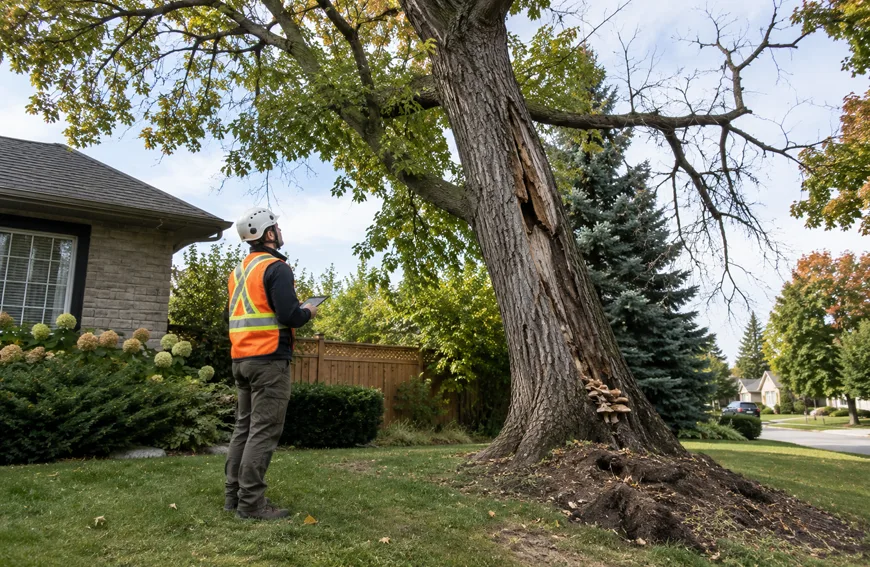
- Mushrooms or fungal growth at the base or along visible roots (a sign of internal decay)
- Soil that has lifted or cracked near the trunk, especially on one side
- Exposed roots that look damaged, cut, or girdling (wrapping around the trunk or other roots)
- Standing water or soggy soil that never seems to drain
A tree with compromised roots can look perfectly healthy above ground while it’s already unstable underground.
Inspect the Trunk
Walk a full circle around the trunk. Look for anything that breaks the smooth, continuous line of the bark.
- Vertical cracks, seams, or splits running up the trunk
- Large sections of missing or peeling bark
- Cavities or hollow spots you can see or hear when tapped
- Oozing sap, dark staining, or sawdust-like material (frass) near the base, which can point to borer activity
A tree can survive with some of these issues for years, but a cracked or hollow trunk under load-bearing stress is one of the more common causes of sudden, catastrophic failure.
Check for Lean and Structural Balance
A slight, long-standing lean isn’t always a problem — many mature trees grow that way naturally. What matters is whether the lean is new, and what the soil around the base looks like.
Warning signs include:
- A lean that has developed or worsened recently, rather than one that’s always been there
- Cracked or heaved soil on the side opposite the lean, which suggests the root plate is shifting
- A tree leaning toward a house, driveway, power line, or area where people regularly walk or park
If you’re not sure whether a lean is old or new, a dated photo comparison from a past season is often the easiest way to check.
Look Up: Canopy and Branch Health
The canopy tells you a lot about a tree’s overall condition, but it’s also where homeowners are most likely to miss subtle problems, since branches are farther away and harder to inspect closely.
- Dead branches, especially large ones (sometimes called “widowmakers”)
- Branches with no leaves while the rest of the tree is fully leafed out
- Co-dominant stems — two main trunks splitting from roughly the same point, which are structurally weaker than a single leader
- Cracks or splits where large branches meet the trunk
- Broken or hanging branches caught in the canopy from a previous storm
Uneven or sparse leaf-out in spring, or early leaf drop in late summer, can also signal stress worth investigating further with regular pruning and trimming.
After a Storm: A Faster Follow-Up Check
Wind, ice, and heavy rain can turn a borderline tree into an urgent one almost overnight. After any significant storm, do a quicker version of this checklist focused on new damage rather than long-term decline.
- New cracks, splits, or leaning that weren’t there before
- Branches caught or hanging in the canopy
- Any visible shift in the root plate or soil around the base
If you spot fresh storm damage near a structure, driveway, or power line, treat it as time-sensitive rather than something to monitor over the season.
When to Call a Professional
This checklist is designed to help you catch red flags early, not to replace a professional assessment. If you find one or more of these warning signs, especially anything involving the trunk, roots, or a tree near your home, the next step is a proper risk evaluation rather than a wait-and-see approach.
A certified arborist can assess structural issues that aren’t obvious from the ground, and in some cases, support systems like cabling and bracing can stabilize a tree rather than requiring removal. Where risk is more serious, emergency tree service may be the safer route.
Five Star Tree Care serves Richmond Hill, Toronto, Markham, Vaughan, Aurora, and Newmarket. If your inspection turns up anything on this list, request a quote or call (416) 990-3355 to schedule an arborist report and get a professional opinion before the next storm rolls through.
For more detail on tree risk indicators, the International Society of Arboriculture’s Trees Are Good resource is a useful reference homeowners can consult alongside this checklist.