
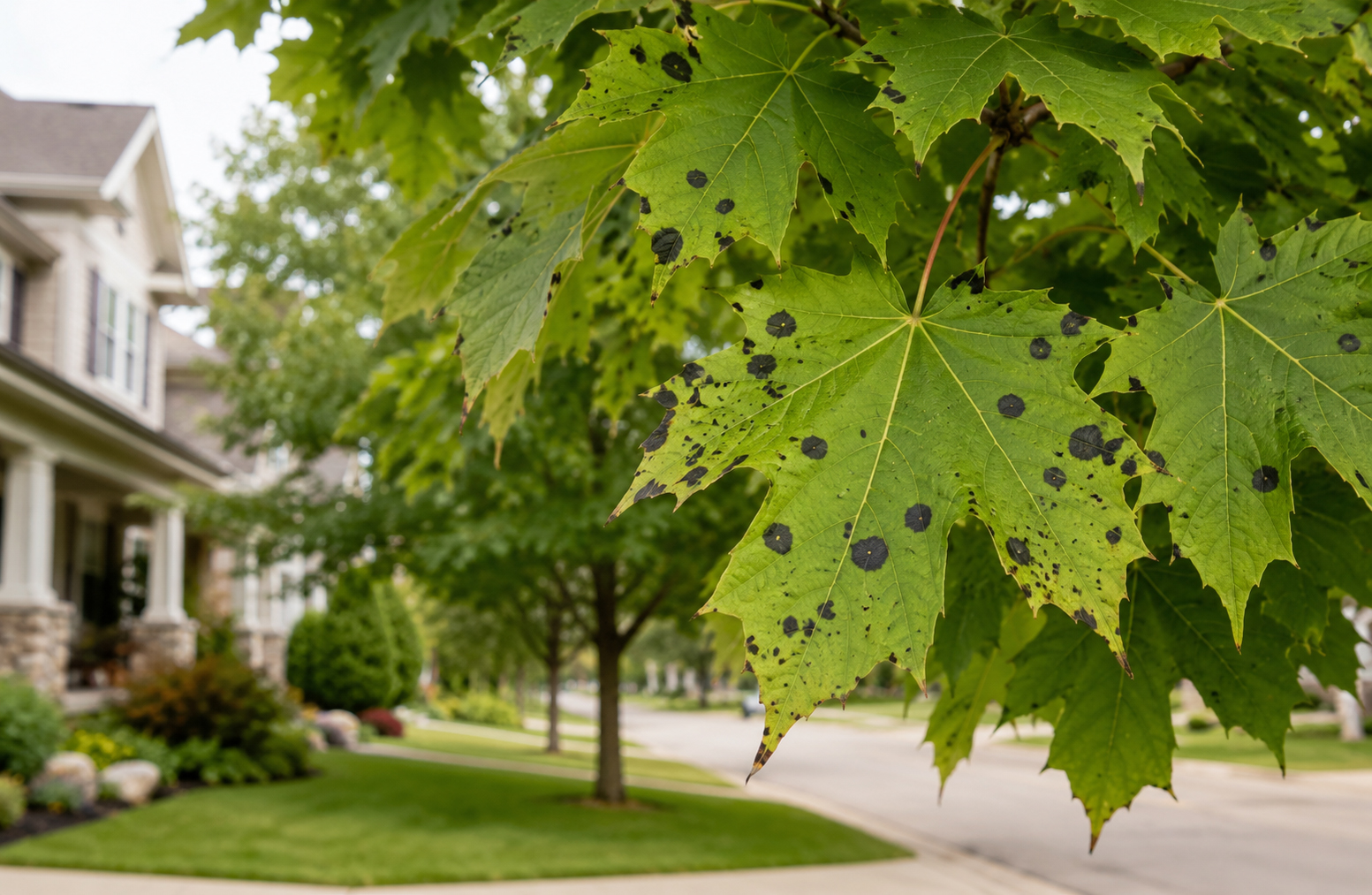
If you’ve walked under a maple tree in the GTA this August and noticed leaves covered in round, shiny black spots that look like someone splashed tar on them, you’re not imagining things. This is one of the most common tree questions homeowners across Richmond Hill, Toronto, Markham, Vaughan, Aurora, and Newmarket ask their arborist every late summer — and the good news is, it’s rarely as serious as it looks.
Here’s what tar spot actually is, why it’s so noticeable on GTA maples specifically, and when it’s worth a professional look.
What Is Maple Tar Spot?
Tar spot is a fungal disease caused by species in the Rhytisma genus. It’s not actually tar — it just looks like it. The disease follows a predictable pattern:
- Spores overwinter on fallen leaves from the previous autumn
- In spring, wet weather carries spores to new leaves
- Pale yellow-green spots appear on leaves through early summer
- By late summer, those spots darken and raise into the familiar shiny black “tar” patches
The fungus affects leaves only — it doesn’t spread into branches, bark, or the tree’s vascular system.
Which Maples Get It Worst
Not all maples are affected equally. In the GTA, tar spot shows up most dramatically on:
- Norway maples — by far the most common host locally, since Norway maples line so many GTA streets and older residential lots
- Silver maples
- Red maples
- Sugar maples (usually more subtle spotting)
Because Norway maples are so widely planted across the region, tar spot tends to look worse here than in areas with more native maple species.
Is It Actually Harming Your Tree?
For the vast majority of cases, no. Tar spot is considered a cosmetic issue rather than a health threat. A tree can carry a heavy tar spot infection for years without any real decline in vigor, since the fungus doesn’t damage the tree’s structure or its ability to produce energy the following season.
That said, two things are worth watching for:
- Premature leaf drop. Severely infected leaves sometimes fall earlier than normal, which can add a bit of stress in a year when a tree is already dealing with something else — drought, construction impact, or an active pest.
- A pattern that isn’t actually tar spot. Some homeowners assume any dark leaf marking is tar spot when it’s really something else. If you’re also seeing dieback, thinning canopy, or bark damage alongside leaf spotting, that’s a different conversation — those are signs more consistent with a real pest problem, like the emerald ash borer currently active across the GTA or the spotted lanternfly spreading toward the region.
Why You Can’t Just Spray It Away
Ontario’s cosmetic pesticide rules limit which products can be used to treat non-life-threatening tree issues like tar spot. As we cover in our guide to tree pesticides in Ontario, only Class 11 pesticides — lower-toxicity products — are permitted for cosmetic fungal issues, and there currently isn’t a registered fungicide in Ontario that reliably controls tar spot once it’s established.
In practice, that means chemical treatment isn’t the realistic path forward for most properties. Sanitation is.
What Actually Helps
Since the fungus overwinters on fallen leaves, breaking that cycle is the most effective thing a homeowner can do:
- Rake and remove fallen leaves each autumn rather than leaving them to decompose under the tree
- Avoid home composting infected leaves unless your pile reaches temperatures high enough to kill fungal spores — most backyard piles don’t
- Improve airflow and light penetration through the canopy with professional pruning and trimming, since the fungus favors damp, still conditions
- Keep an eye on tree vigor overall, since a well-maintained, properly watered tree tolerates cosmetic issues like tar spot far better than a stressed one
None of these steps will eliminate tar spot from your neighbourhood entirely — it’s simply too established in the GTA’s Norway maple population for that. But consistent fall cleanup can noticeably reduce how bad it looks year over year.
When to Call a Professional
Most tar spot cases don’t need an arborist visit on their own. But it’s worth requesting an arborist report if:
- Leaf spotting is accompanied by branch dieback or a thinning crown
- The tree has dropped leaves unusually early for two years running
- You’re not sure whether what you’re seeing is tar spot or a more serious disease or pest
A trained eye can rule out the more serious possibilities quickly, so you’re not left wondering all season whether your maple is actually in trouble.
If you’re noticing heavy leaf spotting on your maples this year, or just want peace of mind that it’s cosmetic and nothing more, Five Star Tree Care serves homeowners throughout Richmond Hill, Toronto, Markham, Vaughan, Aurora, and Newmarket. Request a quote or call us at (416) 990-3355 for a professional assessment.